
Theory test preparation
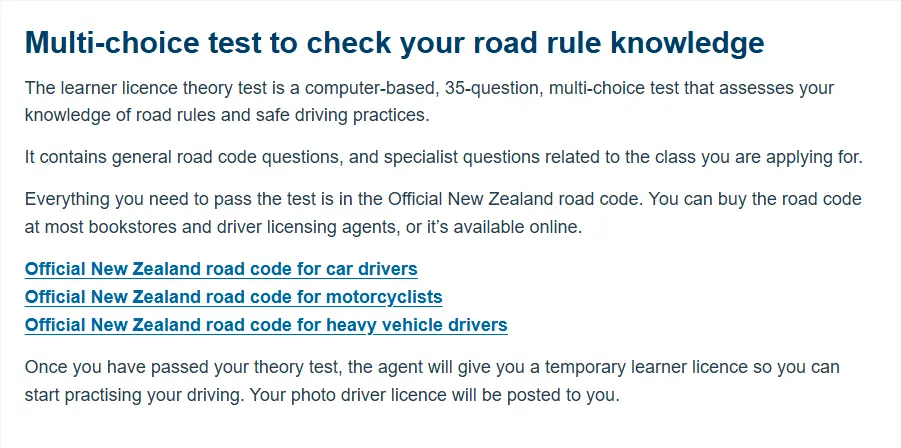
The theory test is a computer-based multi-choice test on the Road Code, sat at a driver licensing agent counter. It is the test that gets you a learner licence — there is no driving in it. You get the result before you leave, and if you do not pass there is a stand-down before you can sit it again.
The theory test is a computer-based multi-choice test on the Road Code, and it is the gate into the whole New Zealand licensing system. Pass it and you can apply for a learner licence. There is no driving in it and no examiner in a car — it is you, a touchscreen, and a set of questions.
It is worth clearing up the naming first, because it drives a lot of confused searching. People look for "the AA driving test". AA is a driver licensing agent: it administers the theory test on NZTA's behalf, along with VTNZ and a range of other appointed providers. The practical driving test is a different test, run by testing officers, booked through a different channel, and sat at designated testing locations. Passing the theory test does not book you a drive, and turning up at an AA branch expecting to be taken out on the road is a wasted trip.
What the test actually covers
The question bank is drawn from the official Road Code, and it is broader than the driving most people do day to day. The topics that consistently sink candidates are the ones that feel like edge cases until you are asked about them:
- Give-way rules, particularly at unmarked intersections and when turning across traffic. These are the questions people get wrong with total confidence.
- Signs and markings you rarely encounter locally — rural, motorway, and roadworks signage.
- Alcohol and drug limits, which differ depending on the licence stage you are on.
- Towing, loads and vehicle condition, which most learners have never thought about.
- What to do at a crash scene, and your legal obligations afterwards.
The test is sat on a touchscreen at the agent counter and marked automatically. You know whether you passed before you walk out.
Preparing properly, not frantically
The single most useful thing you can do is read the actual Road Code rather than a condensed version of it. Summary sites tidy away exactly the qualifications and exceptions the test asks about.
Practice tests are worth doing, but for diagnosis rather than memorisation. The point is to find the three or four topics where you are consistently wrong and then go back to the Road Code on those topics specifically. Working through hundreds of questions in areas you already know is comfortable and useless.
Be careful with third-party practice test sites. Some are excellent; others are stale, wrong, or exist mainly to sell you something. Any site that asks for your licence number, an identity document, or a payment "to book your test" is not a study tool — bookings and fees go through NZTA or an appointed agent, never through a study site.
If English is not your first language, that is worth planning around rather than pushing through. NZTA publishes what language support is available for the theory test and how to arrange it, and arranging it in advance is far easier than discovering the limits on the day.
Where and how you sit it
The theory test happens at an appointed driver licensing agent — AA Centres, VTNZ sites, and in smaller towns sometimes a council service centre or a local provider. Practice varies noticeably here, and this is one of the places where a national rule and a local reality diverge:
Some agents take walk-in theory tests. Others require an appointment. Busy urban branches often stop issuing test slots well before their advertised closing time, because a test that cannot finish before close does not get started. Small-town agents may only run tests on certain days.
The fix is unglamorous: ring the specific branch you intend to use and ask whether they take walk-ins, what time they stop starting tests, and whether they have slots that day. Do not generalise from what a mate did at a different branch in a different city.
The test fee is set by NZTA and normally paid at the counter along with the licence application fee. Current amounts are published on NZTA's licensing fees pages — see how to find the current fees rather than trusting a figure quoted on a forum.
If you do not pass
You cannot sit it again the same afternoon. NZTA sets a stand-down period between attempts and publishes it alongside the test information. You also pay the test fee again for each attempt, which is the practical argument for preparing properly the first time.
What does not happen is your application being thrown out. You are resitting a test within an existing application, not starting from scratch. The details of rebooking, and what tends to change between a first and a second attempt, are on the failed test page.
A failed theory test leaves no lasting mark on your licence record. It is not held against you at the practical stage, and nobody at a later counter will raise it.
One thing to watch before 25 January 2027
A new car licensing system begins on 25 January 2027. Entry testing is an obvious candidate for change under any reworking of the system, so if you are studying now and planning to sit the test months from now, check the 2027 changes page before you commit to a study plan built around today's structure. What we will not do is speculate about what the new test looks like; nobody outside NZTA credibly knows yet.
Frequently asked questions
is the aa driving test the same as the theory test
how do i study for the nz theory test
are the free online practice tests the same as the real one
what happens if i fail the theory test
Sources and verification
- NZ Transport Agency Waka Kotahi. Driver licences, checked 2026-08-12.
- NZ Transport Agency Waka Kotahi. Find a driver licensing agent, checked 2026-08-12.
- New Zealand Automobile Association. Driver licensing agent locations, checked 2026-08-12.
Checked against the sources above. If something has changed, tell us.