
When is my WoF due?
From 1 November 2026 most vehicles between 4 and 14 years old move from annual to two-yearly Warrant of Fitness inspections — but only if they were first registered on or after 1 November 2019. Vehicles registered between November 2013 and October 2019 wait until 1 November 2027. Enter your first registration date below and this works out which band you are in. Nothing is sent anywhere.
Working out when your next Warrant of Fitness falls due used to be simple: for most cars it was every year, and the date was on the label. From 1 November 2026 that stops being true for a large share of the fleet, and the rule that replaces it depends on two things at once — how old your vehicle is and when it was first registered.
That combination is what makes it confusing. Two cars built in the same year can end up on different inspection intervals right through 2027, purely because one was first registered a few weeks either side of a cut-off date.
Work out your interval
Loading the tool…
This runs entirely in your browser. We do not ask for your plate number, we do not send anything to a server, and we could not tell you what you entered even if someone asked us. It also means the tool keeps working when NZTA's site does not.
What the tool can and cannot tell you
It gives you your inspection interval — how often your vehicle needs a WoF. That is the thing the November 2026 changes actually alter, and the thing most people are trying to find out.
It cannot give you your expiry date, because that depends on when your last inspection was issued, and we would need your vehicle's record to know it. Any tool that claims to work that out without your plate number is guessing. Your real date is printed on the label on your windscreen, and NZTA's checker will confirm it.
We could have asked for your plate and looked it up. We deliberately do not — see our editorial policy for why that line matters to us.
The bands, in plain terms
From 1 November 2026:
- New light vehicles get their second WoF at four years instead of three.
- Vehicles 4 to 14 years old, first registered on or after 1 November 2019 move from annual to two-yearly.
- Vehicles 4 to 14 years old, first registered between 1 November 2013 and 31 October 2019 stay annual for now and move to two-yearly on 1 November 2027.
- Vehicles 14 to 26 years old are unaffected and stay annual.
- Vehicles first registered before 1 January 2000, including motorcycles, move from six-monthly to annual.
The full detail, including the extra checks being added to the inspection itself, is in what changes on 1 November 2026.
A longer interval is not a longer warrant
Worth saying plainly, because it is the misunderstanding most likely to cost someone money: moving to a two-yearly interval does not extend the WoF you already hold. Your current one expires when it says it expires. The new interval applies to the certificate issued at your next inspection.
It also does not change what happens if you get caught with an expired one. There is no grace period, and the infringement fee is $200.
A longer gap between inspections puts more weight on you noticing problems yourself. Two years is a long time for tyres and brakes to quietly go out of specification, and an inspection interval is a legal minimum rather than a maintenance schedule.
If your inspection does not go to plan
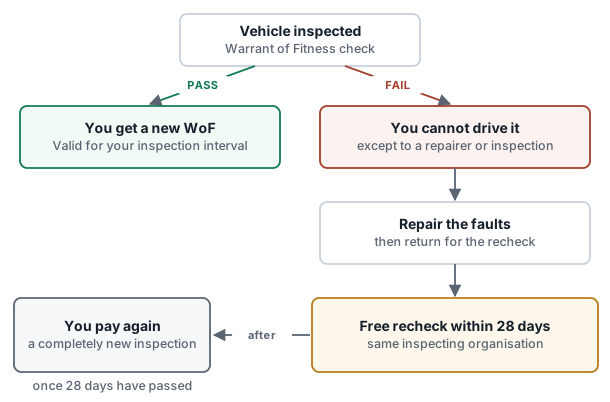
What happens after an inspection, including the 28-day free recheck window.
If your vehicle fails, you cannot drive it except to take it for repair or for a new WoF — and only if it is safe to do so. You then have 28 days from the failed inspection for a free recheck, provided you return to the same inspecting organisation. What to do when your WoF fails covers it properly, and there is a recheck deadline calculator if you want the date.
Frequently asked questions
Does this tell me my actual WoF expiry date?
Why does the first registration date matter so much?
Does the date mean when I bought it or when it was first registered?
Do I need to do anything on 1 November 2026?
Does this apply to my motorcycle?
Sources and verification
- NZ Transport Agency Waka Kotahi. Warrant of Fitness, checked 2026-08-12.
- NZTA Vehicle Inspection Portal. Changes to light vehicle inspections from 1 November 2026, checked 2026-08-12.
- NZTA Vehicle Inspection Portal. In-service WoF and CoF — inspection and certification process, checked 2026-08-12.
Checked against the sources above. If something has changed, tell us.